




What Is Depth Conversion? Unlocking Accurate Subsurface Mapping with Modern Capabilities
Accurate subsurface mapping is essential across energy, environmental, and engineering sectors. One of the most important tools in the geoscientist’s toolkit is depth conversion formula – the process of transforming seismic data from time (two-way travel time) into true geological depth. This seemingly simple concept has profound implications for everything from hydrocarbon exploration to carbon storage site analysis, and even large-scale infrastructure development.
Today’s advanced depth conversion methods offer more precision, speed, and insight than ever before, thanks to powerful software, better velocity modelling, and integration with geological and petrophysical data.
What Is Depth Conversion?
Seismic data is typically acquired and processed in time (TWT – two-way travel time), because that’s how seismic waves are recorded—by how long they take to travel through the Earth and bounce back. But drilling, reservoir development, and engineering projects require information in true depth units (meters or feet).
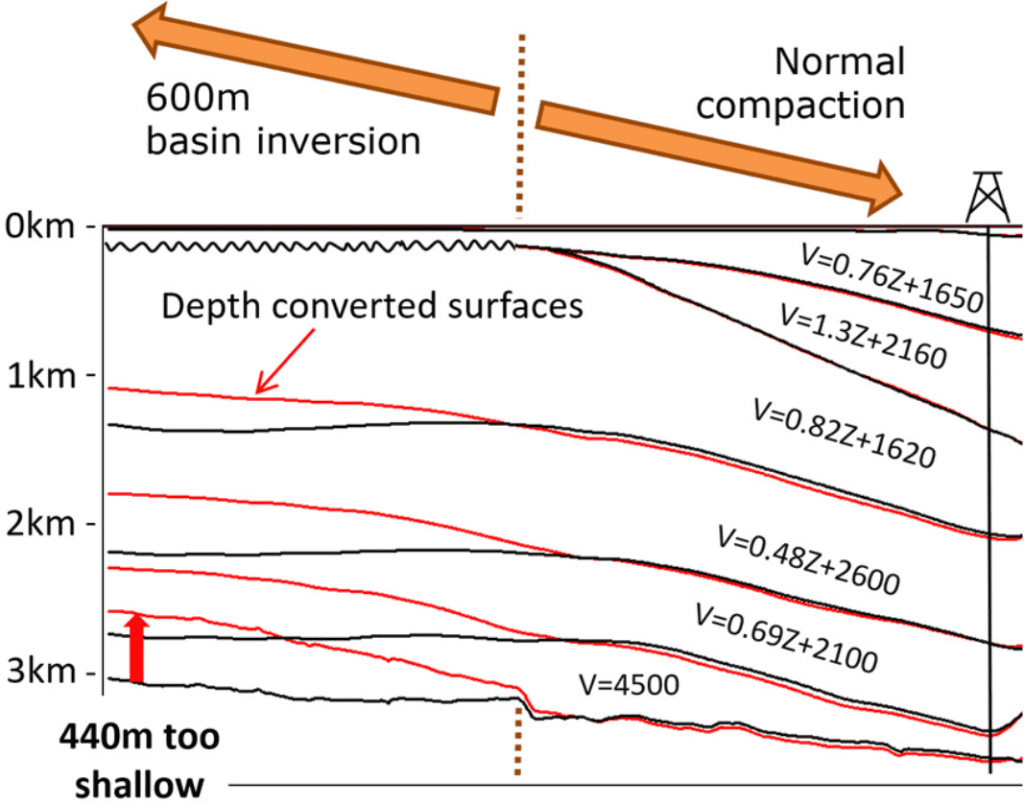
Depth conversion bridges this gap by applying velocity models to seismic data, converting the time-based image into a depth-based one. The result: an accurate, actionable geological map that reflects the actual positions of formations, faults, and reservoirs beneath the surface.
Key Capabilities of Modern Depth Conversion
- Accurate Structural Mapping
Depth conversion allows geoscientists to precisely define the shape, position, and size of geological structures. This is essential for locating reservoirs, assessing traps, and planning wells with minimal drilling risk. - Advanced Velocity Modelling
Modern depth conversion integrates complex velocity models, including vertical and lateral variations, anisotropy, and interval velocity derived from well logs and seismic data. This results in far more reliable depth estimations. - Multiple Conversion Methods
Today’s workflows support a range of conversion techniques, such as:
- Layer-based conversion
- Grid-based conversion
- Well-tie integration
- Geostatistical and Bayesian approaches
These methods can be adapted depending on data quality and geological complexity.
- Integration with Well Data
By incorporating well tops, check shots, and VSP data, modern depth conversion workflows tightly calibrate seismic data with real subsurface measurements—enhancing confidence in the final model. - Real-Time Scenario Testing
With powerful 3D visualization and fast computing, interpreters can quickly test alternative velocity models and geologic scenarios to evaluate uncertainty and improve decision-making in exploration or development planning.
Applications Across Industries
Depth conversion is critical across a range of geoscience-driven industries:
- Oil & Gas Exploration: Convert time maps to depth for accurate drilling and reservoir delineation.
- Carbon Capture & Storage (CCS): Define secure storage layers and monitor CO₂ migration in true depth.
- Mining: Map ore bodies and plan extraction with precise depth models.
- Geothermal: Identify heat reservoirs and fracture zones.
- Civil Engineering: Support tunnelling, dam construction, and foundation design with accurate subsurface models.
Software and Tools Supporting Depth Conversion
Industry-standard platforms like Kingdom, Petrel, and Paradigm now offer powerful, user-friendly depth conversion modules. These tools allow for:
- Velocity model building
- Horizon-based conversion
- Integration with seismic inversion and attribute analysis
- 3D depth visualization
They also support collaborative workflows where geophysicists, geologists, and engineers can contribute to a unified subsurface model.
The Future of Depth Conversion
As machine learning and cloud computing evolve, depth conversion is becoming more dynamic and data-driven. Expect to see:
- AI-assisted velocity model generation
- Automated uncertainty quantification
- Real-time updates during drilling or subsurface monitoring
- Cross-discipline integration for full asset lifecycle modelling
Depth conversion is far more than a simple mathematical process—it’s a cornerstone of accurate subsurface interpretation. With modern capabilities, it delivers the precision and reliability needed to reduce drilling risk, optimize resource extraction, and support safe, sustainable engineering projects.
Whether you’re building a reservoir model or designing infrastructure, depth conversion turns seismic data into real-world insights—right where you need them, in the true depth domain.