



Choosing a White Gold Engagement Ring for Daily Wear
White gold can look clean and understated beside a diamond, but appearance is only one part of the buying decision. The metal’s purity, alloy composition, surface finish, setting style, and future maintenance can all affect how the ring performs after years of regular wear.
For someone shopping in Germany, it also helps to understand fineness marks such as 585 and 750, how ring sizing is handled, and how the engagement ring will sit beside a future wedding band. Thinking about these details before choosing the design can prevent compromises later.
585 or 750 White Gold Changes More Than the Stamp
White gold is made by combining gold with other metals to produce a paler alloy. The exact composition varies between manufacturers, so two rings carrying the same gold fineness can still differ slightly in colour, hardness, and feel.
In Germany and other European markets, you may commonly see gold described by fineness.
- 585 gold contains 58.5% pure gold and corresponds to 14-karat gold.
- 750 gold contains 75% pure gold and corresponds to 18-karat gold.
A higher gold percentage does not automatically make a ring better for every buyer. 750 white gold contains more pure gold, while 585 white gold can offer greater resistance to everyday knocks depending on the alloy formulation.
For an engagement ring that will be worn almost every day, the practical question is how you balance gold content, wear resistance, appearance, and budget.
The Bright White Finish May Come From Rhodium
Many white gold rings are rhodium-plated to disguise the off-whiteness of the gold and create a whiter, colder appearance. This added coating is sometimes used to achieve a more contrasting color to a colorless or near-colorless diamond.
Rhodium plating does not last forever, as the wear and friction from the ring against other surfaces will eventually cause the finish to be worn away on the lower part of the shank, where the ring often comes into contact with objects such as tables and countertops, doorknobs, exercise equipment and rings that might be worn in the same hand.
The reemerging white gold will not have the exact same coloring as the rhodium-plated surface, but it should not be considered damaged, since that is the natural color of the underlying metal.
It is always a good idea to inquire whether a white gold ring is rhodium-plated and what the care recommendations are for the type of finish. Buyers who want to avoid frequent re-finishing should also consider the pros and cons of platinum.
Match the Setting to the Way the Ring Will Be Worn
The centre stone tends to hog all the glory when it comes to engagement-ring shopping, but setting plays a large role in terms of security and convenience.
A higher solitaire could draw attention to the diamond, and it might help to have a wedding band that would run close and unobtrusive to the engagement ring, but at the cost of greater exposure. A lower setting might keep the diamond close to one’s finger, but provide less room for a straight wedding band.
Bezel settings enclose more of the diamond’s perimeter in metal, and they might be a good choice for people who work a lot with their hands, or find that prongs are a nuisance, but they provide an entirely different look than a traditional claw setting would.
Pavé bands incorporate smaller diamonds along the shank, but resizing and general maintenance can be more involved than with a standard band.
The useful question is not simply which design looks attractive in a photograph. Consider how often the ring will be worn, what your hands encounter during a normal week, and how much maintenance you are comfortable arranging.
Diamond Colour Can Look Different Against White Metal
White metal creates a relatively neutral background around the centre diamond. This has the effect of making distinctions in body colour of the diamond easier to see compared to what it might look like in yellow or rose gold.
This does not mean that you need the absolute best white metal for your needs.
Diamond shape, size, setting, and individual sensitivity to colour all influence what one might see. One could very well have a beautiful cut diamond with a slightly lower colour grade that offers more value to the buyer’s budget than one that they wouldn’t be able to distinguish without side-by-side comparison at a lab.
If you’re considering lab-grown diamonds, you should look over the grading report the same way you would look at one for another graded diamond. You need to take into account the stone’s measurements, cut details if applicable, colour, clarity, proportions, and any fluorescence information that may have been included in the report.
A grading report certifies what the characteristics of a given diamond are. It should not be used as a certainty that two diamonds with identical grades are going to look identical.
Check Proportions, Not Carat Weight Alone
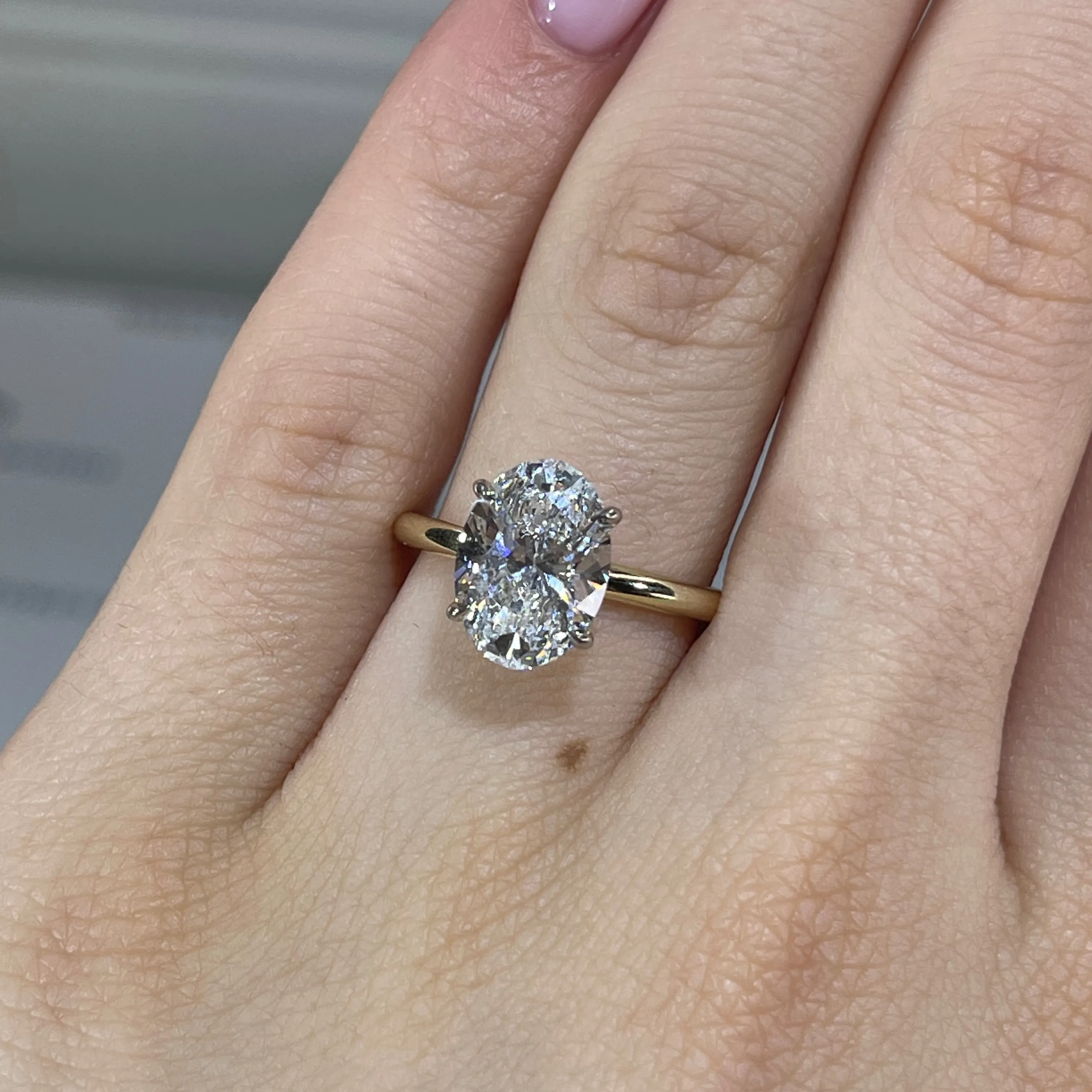
Two diamonds can have the same carat weight but look different in size due to the fact that it measures the weight of the stone rather than its surface area.
This is especially evident in elongated shapes like oval, emerald, radiant, pear, and marquise cuts. The length to width ratio affects the overall silhouette, therefore making the stone appear larger or more slender.
Before choosing a certain setting remember to check what the actual size of your diamond is rather than the carats.
For white gold engagement rings shopping tips, looking at the measurement and the setting size can also indicate an outline of a finished ring, rather than looking at the stone alone.
Plan for the Wedding Band Before Ordering
An engagement ring is often purchased months or even years ahead of the wedding band, but the style of the first ring may dictate what styles of wedding rings will fit.
A straight shank wedding band may nestle against certain solitaires, while others have a basket, halo or shallow centre that create a small space between the two rings.
That space may be deliberate. Some couples want a bit of a gap, while others prefer a curved, shaped or bespoke band that follows the shape of the engagement ring.
If a flush pairing is important to you, ask how high the centre stone is, and look at the side view rather than the plan view to see if the band would sit nicely next to your solitaire.
This is especially important when buying online, where a ring may appear flat in a photograph, when in reality it has a series of steps or slopes to follow the shape of your engagement ring.
Get Ring Size and Resizing Limits Clear Early
European ring sizing often relates closely to the inner circumference of the ring in millimetres. Even so, sizing conventions and conversion charts can differ between retailers, so follow the jeweller’s own measurement method before placing an order.
Band width also affects fit. A wider ring can feel tighter than a narrow band with the same nominal size.
Design complexity matters too. Plain solitaire bands are often easier to resize than bands containing pavé diamonds around much of the circumference. Full-eternity styles may have very limited resizing options.
Before confirming the ring, ask:
- How is the recommended size measured?
- Can this exact design be resized later?
- How much resizing is possible?
- Will resizing affect pavé stones or engraving?
- What happens if the first size ordered is incorrect?
These questions are especially useful for custom or online orders.
Think About Maintenance as Part of the Design
The most sensible rings are those that require the type of upkeep you’re willing to perform
White gold may need lab made diamonds cleaning, checking, polishing, and replating, depending on how the ring is finished and worn. The prongs should always be examined to ensure that they are securing the centre stone, since they can wear with time.
If you want something that requires less daily maintenance, a simple band with a secure setting might be more desirable than a heavily detailed ring, set with smaller stones.
On the other hand, if intricate pavé detail, a hidden halo, or a high-profile centre stone are more important to you, remember that a regularly scheduled inspection is always a good idea, regardless of style
Picking out the metal purity, diamond proportions, setting height, band thickness, and how it will look with a wedding band in the future will help you narrow down your preferences.